

Learn how to build a 1 lakh stock portfolio in India even if you are a complete beginner. Do you have ₹1,00,000 sitting in your savings account and want to deploy it into the Indian stock market to build long-term wealth? If yes, you have made a phenomenal decision.
A common misconception among beginner investors is that you need tens of lakhs to build a meaningful investment portfolio. The truth is quite the opposite: ₹1 Lakh is the absolute sweet spot for any beginner. It is large enough to give you practical exposure to diversification and corporate actions, yet small enough that any initial mistakes won’t cause catastrophic financial ruin.
Table of Contents
In this comprehensive guide, we will break down the exact step-by-step strategy to construct a robust, high-yielding, and resilient ₹1 Lakh stock portfolio tailored for the current market landscape.
1. Prerequisites: The Financial “Launchpad”
Before you deploy a single rupee into the stock market, you must ensure your financial house is in order. Entering the market under stress forces you to make emotional decisions. Ensure these three boxes are checked:
- The Emergency Fund Buffer: Never invest money that you might need for rent, groceries, or medical emergencies over the next 6 to 12 months. Your ₹1 Lakh investment capital must be entirely separate from your emergency savings.
- Zero Toxic Debt: If you are paying 14% interest on a personal loan or 40% annually on credit card debt, pay that off first. No predictable stock market strategy yields a guaranteed return higher than the guaranteed bleeding of high-interest debt.
- The 3-to-5-Year Horizon: Equities are inherently volatile in the short term. Approach this with a wealth-creation mindset, intending to leave this money untouched for at least 3 to 5 years to let compounding work its magic.
2. The Core-Satellite Framework: Balancing Safety and Growth
When managing a portfolio of ₹1 Lakh, you cannot afford to put all your eggs in one basket, nor can you afford to spread your capital too thin across 30 different stocks. To solve this, professional fund managers use a targeted strategy. When figuring out how to build a 1 lakh stock portfolio, the Core-Satellite Strategy provides the perfect balance.
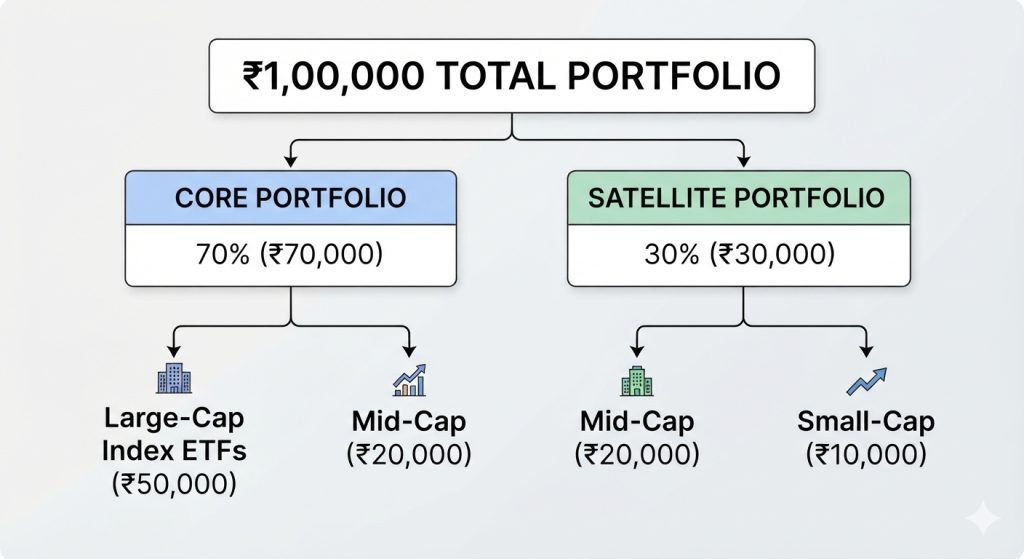
The Core (70% Allocation — ₹70,000)
This forms the foundational bedrock of your portfolio. The primary objective here is capital preservation, steady compounding, and downside protection during market crashes. This money goes into structural market leaders—companies with massive economic moats, pristine balance sheets, and consistent dividend payouts.
The Core (30% Allocation — ₹30,000)
This acts as your portfolio’s growth accelerator. The objective here is “Alpha Generation”—outperforming the broader market benchmark index. This money is allocated to faster-growing Mid-Cap and high-potential Small-Cap companies that carry higher risk but offer explosive capital appreciation.
3. The Blueprint: How to Build a 1 Lakh Stock Portfolio
To prevent emotional over-diversification, a ₹1 Lakh portfolio should strictly hold between 8 to 12 individual stocks/instruments. Holding more will dilute your returns, turning your portfolio into an expensive, self-made mutual fund.
Here is the ideal mathematical blueprint for your capital deployment:
| Asset Category | Allocation % | Capital Amount | Strategic Objective | Number of Holdings |
|---|---|---|---|---|
| Large-Cap Market Leaders | 50% | ₹50,000 | Portfolio Stability & Regular Dividends | 4 – 5 Stocks |
| Broad Index ETFs | 20% | ₹20,000 | Passive Tracking of India’s Growth | 1 – 2 ETFs |
| Mid-Cap Mid-Sized Giants | 20% | ₹20,000 | High Growth with Moderate Volatility | 2 – 3 Stocks |
| Small-Cap Aggressive Growth | 10% | ₹10,000 | High-Risk, Maximum Potential Return | 1 – 2 Stocks |
| Total | 100% | ₹1,00,000 | Balanced, Multi-Cap Wealth Creation | 8 – 12 Total |
4. Key Structural Sectors for the Next Decade
India remains one of the fastest-growing major economies globally, driven by demographic dividends, urbanization, and structural reforms. If your goal is learning how to build a 1 lakh stock portfolio that beats inflation, your capital must align with the primary sectors driving this economic transition:
- Banking & Financial Services (BFSI): Credit growth is the fuel of any economy. As corporate credit picks up and retail financialization deepens, dominant private banks and digital wealth management platforms will capture massive value.
- Consumption & FMCG: With a population exceeding 1.4 billion, domestic consumption is a secular, unstoppable trend. Premiumization—consumers upgrading from unbranded to branded goods—presents a long-term multi-decade growth runway.
- Technology & Digital Transformation: Beyond traditional IT services, Indian companies are rapidly pivoting towards cloud computing, AI implementation, and global engineering research & development (ER&D).
- Manufacturing, Infrastructure & Defense: Driven by government capex and the global “China+1” supply chain diversification strategy, domestic manufacturing, electronics assembly, and defense indigenization are witnessing unprecedented order book visibility.
5. Stock Selection Methodology: A 4-Step Fundamental Framework
You must teach your blog readers how to filter out market noise and select individual stocks based on cold, hard data.
Never buy a stock based on a viral video, social media tip, or TV news headline. Apply this strict checklist to every stock:
Step 1: Revenue and Profit Trajectory
The company’s top-line (Sales) and bottom-line (Net Profit) must showcase a consistent upward trajectory over a rolling 5-year period. Look for an annualized growth rate (CAGR) of at least 12% to 15%. Consistent profit growth is the ultimate engine behind rising stock prices.
Step 2: Return on Equity (ROE) & Return on Capital Employed (ROCE)
These capital efficiency metrics reveal how effectively the management deploys shareholders’ funds to generate profits. Consistently target companies boasting an ROE and ROCE higher than 15%. Anything lower indicates the management is destroying economic value.
Step 3: Debt Evaluation (Debt-to-Equity Ratio)
High debt is a corporate silent killer, especially during macroeconomic slowdowns or high-interest-rate environments. For non-banking companies, strictly target businesses with a Debt-to-Equity ratio of less than 0.5, or ideally, entirely debt-free companies with deep cash reserves.
Step 4: Margin of Safety (Valuation Analysis)
A phenomenal company can be a terrible investment if you pay an absurdly inflated price for it. Analyze the company’s current Price-to-Earnings (P/E) ratio against its own 5-year historical average and its direct sectoral peers. Ensure you buy when valuations are reasonable relative to their long-term growth prospects when figuring out how to build a 1 lakh stock portfolio safely.
6. A Model ₹1 Lakh Portfolio Blueprint
To give your readers concrete clarity, let’s explore a theoretical structural allocation framework displaying exactly how a ₹1 Lakh portfolio can be constructed across various market caps.
A. Large-Cap Bedrock Allocation (₹50,000)
- The Financial Anchor (₹12,500): A banking titan (e.g., ICICI Bank or HDFC Bank) capturing the core credit growth of India’s retail and corporate segments.
- The Consumption Cushion (₹12,500): A dominant FMCG powerhouse (e.g., Hindustan Unilever or ITC) ensuring highly resilient cash flows, defensive product demand, and steady dividend yields.
- The Tech Engine (₹12,500): A global technology service provider (e.g., TCS or Infosys) acting as a cash-generating machine with a very high return on capital.
- The Industrial Conglomerate (₹12,500): A diversified mega-cap corporate house (e.g., Reliance Industries) with systemic footprints spanning oil-to-chemicals, retail, and digital telecommunications.
B. Passive Index ETF Allocation (₹20,000)
Nifty 50 or Nifty Next 50 ETF (₹20,000): Allocating capital to a low-cost Nifty index fund guarantees that your portfolio will never underperform the structural economic growth of India’s top corporate entities. It automatically manages stock exits and entries for you passively.
C. Mid-Cap Growth Engines (₹20,000)
- The Automotive / EV Derivative (₹10,000): An aggressive auto major or primary component manufacturer capitalizing on premium vehicle demand and the systemic shift toward electric vehicle platforms.
- The Healthcare / Pharma Pioneer (₹10,000): A domestic healthcare delivery network or specialized pharmaceutical player benefiting from rising household incomes and aging demographics.
- Choosing mid-sized companies with strong management is a vital step when planning how to build a 1 lakh stock portfolio for aggressive growth.
D. Small-Cap Alpha Generators (₹10,000)
The Niche Industrial Leader (₹10,000): Split across 1 or 2 small-cap players dominant within their micro-niches—such as specialized chemicals, green energy components, or localized defense electronics manufacturing—where earnings growth can skyrocket rapidly.
7. Portfolio Risk Management: Crucial Mistakes to Avoid
Building a portfolio is only half the battle; defending your capital from behavioral errors is where long-term wealth is actually won. Instruct your readers to actively guard against these rookie mistakes:
- The Peril of Sectoral Concentration: If you are incredibly bullish on the IT sector or green energy, do not put ₹60,000 of your portfolio into that single theme. When a sector undergoes an industry-wide cyclical downturn, concentrated portfolios take years to recover.When learning how to build a 1 lakh stock portfolio, concentrated holdings leave you highly vulnerable to steep corrections.
- Chasing the Allure of “Penny Stocks”: Buying 5,000 shares of a fundamentally bankrupt ₹2 company instead of 2 shares of a high-quality ₹5,000 market leader is an absolute psychological trap. Stocks are cheap for a reason. Focus on intrinsic corporate quality, not nominal share prices.
- Falling Victim to FOMO (Fear of Missing Out): Never buy a stock simply because it has hit a consecutive upper circuit or because everyone in your social circle is talking about it. Buying at the absolute absolute peak of market euphoria leaves you highly vulnerable to steep corrections.
- Hyperactive Portfolio Monitoring: Checking your brokerage application multiple times a day turns a long-term investment journey into a source of emotional anxiety. It inevitably tricks you into over-trading, racking up unnecessary brokerage fees, short-term capital gains taxes (STCG), and DP charges.
8. Execution Strategy: Lumpsum vs. Phased Staggering
A very common question beginners ask is: “Should I deploy the entire ₹1 Lakh on day one?” The ideal response is a definitive No. Deploying all your capital in a single trading session exposes you to severe immediate timing risk. If you want to know how to build a 1 lakh stock portfolio successfully without panic, a phased approach is much better.
Instead, utilize a Phased Deployment Strategy over 3 to 4 months:
- Deploy an initial lump sum of roughly ₹30,000 immediately to establish your core benchmark positions.
- Keep the remaining capital in your linked savings account or a liquid fund.
- Systematically deploy ₹20,000 to ₹25,000 every single month, deliberately utilizing any sharp market drawdowns or red days to average out your long-term purchase costs. This approach leverages the power of rupee-cost averaging perfectly.
9. Conclusion
Building a ₹1 Lakh stock portfolio is a defining milestone along your personal journey toward true financial freedom. The actual value of this portfolio isn’t just the monetary return it yields over the next year—it is the invaluable investing habits, financial discipline, and fundamental knowledge you develop along the way.
Markets will fluctuate, corrections will occur, and cycles will turn. However, if you remain anchored to fundamental business performance, maintain a highly diversified portfolio structure, and keep a steadfast long-term horizon, this initial ₹1 Lakh portfolio can serve as the foundational seed for a massive lifetime fortune.
Mastering how to build a 1 lakh stock portfolio is a defining milestone along your personal journey toward true financial freedom.
Open your Demat account, execute your fundamental research meticulously, and take your first step into the market with absolute confidence today!
Disclaimer: This article is strictly for educational purposes and does not constitute formal financial advice. Equity investments are subject to systemic market risks. Please read all related documents carefully and consult a SEBI-registered financial advisor before deploying real capital.
