
Table of Contents
Introduction
Every morning at 9:15 AM, as the Indian stock market opens, millions of derivative traders face a critical decision. They find themselves stuck in the ultimate trading dilemma: nifty 50 vs bank nifty—which index should they trade today? These two major indices on the National Stock Exchange (NSE) account for the vast majority of intraday and options trading volume in India, acting as the two main pillars of Dalal Street.
For retail traders, making the wrong choice isn’t just a matter of preference; it can completely destroy a trading account. A breakout strategy that works flawlessly on one index can result in a violent stop-loss hunt on the other. To build a consistently profitable approach, you need to understand the underlying mechanics, risk profiles, and unique chart behaviors of both trading instruments.
Let’s dive deep into this comprehensive guide on nifty 50 vs bank nifty to find out which index perfectly aligns with your personal trading style and risk tolerance.
The Fundamental Differences: Nifty 50 vs Bank Nifty
Before entering a trade, you must understand what moves these indices under the hood. Their core composition dictates how they react to news, data, and daily market momentum.
1. Nifty 50: The Diversified Battleship
Nifty 50 represents India’s flagship equity benchmark. It tracks the 50 largest, most liquid blue-chip companies across more than 13 distinct sectors of the economy. Think of it as a massive, stable battleship. Because it contains top companies from IT, Energy, FMCG, Automobiles, and Banking, it is inherently diversified. If tech stocks are crashing on a particular day, a rally in banking or energy stocks can cushion the blow, keeping the index movements relatively balanced.
2. Bank Nifty: The High-Velocity Fighter Jet
Bank Nifty, on the other hand, is a highly focused sectoral index. It tracks the performance of the 12 premier public and private sector banks in India, heavily dominated by giants like HDFC Bank, ICICI Bank, and SBI. Think of it as a supersonic fighter jet. There is no sectoral diversification here. If the Reserve Bank of India (RBI) makes a sudden interest rate announcement, or if global banking sectors face pressure, all 12 stocks move violently in the same direction, causing massive index swings.
1. Volatility and Momentum: Which Is Friendlier for Traders?
The absolute biggest separator between nifty 50 vs bank nifty is the speed and magnitude of their intraday movements.
The High-Beta Nature of Bank Nifty
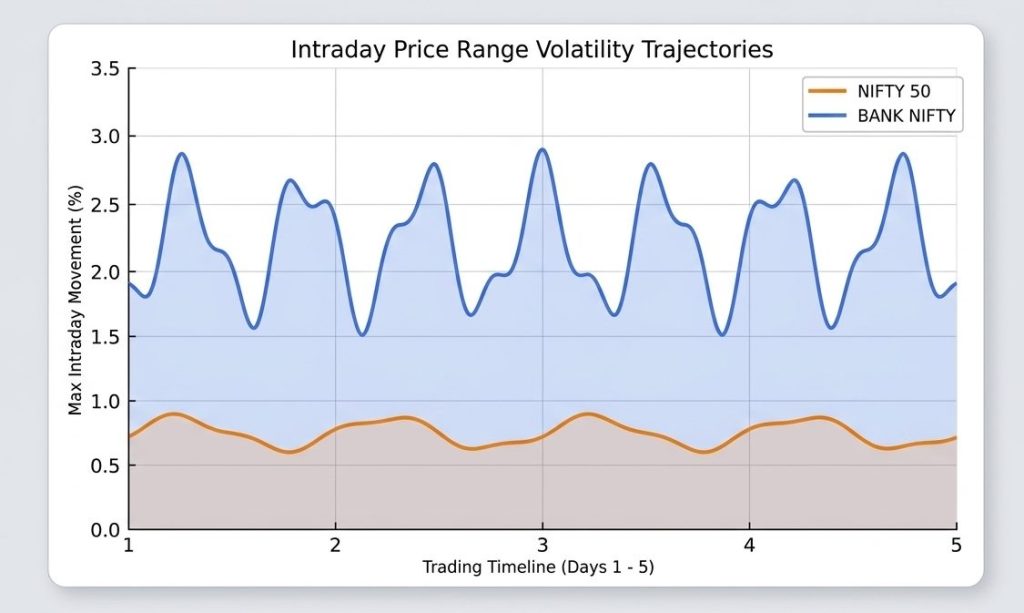
Bank Nifty is a playground for adrenaline seekers. It is a high-beta index, meaning it moves fast and hard. It is completely normal for Bank Nifty to swing by 1.5% to 2.5% in a single trading session, covering hundreds of points within minutes.
For options buyers, this hyper-volatility is a golden opportunity. When momentum kicks in, premium prices explode, turning cheap out-of-the-money (OTM) options into massive winners very quickly. However, this is a double-edged sword. If the trade moves against you by even a fraction, the premium melts away just as fast, leading to severe drawdowns.
The High-Beta Nature of Bank Nifty
Nifty 50 prefers measured, predictable movements. An average daily move for Nifty 50 stays around 0.6% to 1%. Because it is balanced by multiple sectors, its support and resistance levels are much cleaner and more reliable. False breakouts happen far less frequently here compared to Bank Nifty. For systematic traders who rely heavily on classical chart patterns, moving average crossovers, and strict price action, Nifty 50 provides a much calmer environment to execute trades without emotional panic.
The Bank Nifty Surge
Bank Nifty is a high-beta index. It is common to see it rally or crash by 1.5% to 2.5% in a single trading session, sweeping past hundreds of points within minutes. For options buyers, this hyper-volatility provides explosive momentum that can turn low-premium options into multi-bagger wins rapidly. However, the flip side is brutal: a minor counter-trend whip can obliterate your capital just as quickly.
The Nifty 50 Stability
Nifty 50 moves with measured, predictable strides. A 0.8% to 1.2% daily move is considered a big day for the main index. Because it is structurally anchored by diverse sectors, its support and resistance levels are cleaner, more reliable, and much less prone to abrupt, erratic false breakouts.
2. Structural Trading Parameters
To plan your trades, you must evaluate the operational mechanics of both (nifty 50 vs bank nifty) instruments.
TRADING INDEX (nifty 50 vs bank nifty) COMPARISON MATRIX
| Parameter | Nifty 50 | Bank Nifty |
|---|---|---|
| Component Stocks | 50 Stocks | 12 Stocks |
| Avg. Intraday Movement | Moderate | Hyper-High |
| Technical Retests | Very Clean | Aggressive |
| Capital Required | Moderate | Higher Margin |
Risk vs. Reward Profiles
- Option Premium Decay: Because Bank Nifty commands higher implied volatility (IV), its option premiums are expensive. If the market goes sideways, the time decay (Theta) chips away at option buyers aggressively. Nifty 50 options feature lower IVs, making them cheaper to purchase and safer to hold during intraday consolidations.
- Slippage and Liquidity: Both indices possess massive institutional volume. However, during high-impact news breaks, Bank Nifty spreads can widen suddenly, leading to higher trading slippage when market orders are executed. Nifty 50 maintains thick, uninterrupted order books that ensure tight entries and exits even during rapid adjustments.
3. Which Index Suits Your Trading Psychology?
To end the nifty 50 vs bank nifty debate for your personal journey, you must map these indices to your trading profile and psychological tolerance.
Profile A: The High-Speed Scalper & Momentum Trader
If your trading strategy involves catching sharp, 5-minute momentum bursts, trading weekly options breakouts, or exploiting rapid intraday swings, Bank Nifty is your playground. The sheer velocity ensures that your targets are hit quickly if your direction is accurate.
Profile B: The Systematic Trend Follower & Position Builder
If you prefer identifying structural day trends, relies heavily on moving average crossovers, price action patterns, and wants to avoid sudden stop-loss hunting spikes, Nifty 50 is vastly superior. It provides the breathing space needed to let a trend mature without erratic shakeouts.
Profile C: The Conservative Risk-Averse Beginner
If you are transitioning from equity trading to F&O, start strictly with Nifty 50. Bank Nifty’s aggressive drawdowns can cause emotional panic, leading to forced liquidations and flawed execution styles early in a trading journey.
4. Correlating Margin Efficiencies
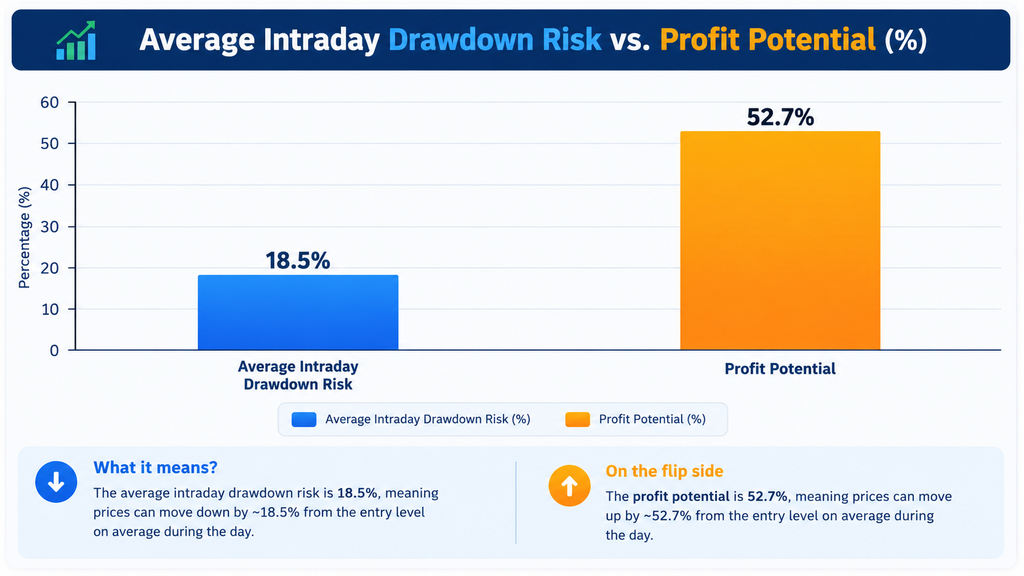
To optimize trade execution, we must evaluate capital deployment and leverage returns against the intrinsic risk across both indices(nifty 50 vs bank nifty).
[visualizer id=”982″ class=””]
The statistical data highlights why position sizing must be scaled down when shifting capital into sectoral trading instruments to protect against abrupt downside spikes.
5. Strategic Rules for Index (nifty 50 vs bank nifty) Success
Regardless of your chosen instrument, adhere to these three golden execution frameworks:
- Never Trade Both Simultaneously: Avoid tracking and trading both indices at the exact same moment. Focus your attention entirely on one matrix to truly absorb its rhythm, volume depth, and distinct candlestick footprints.
- Watch the Heavyweights: If you trade Bank Nifty, keep a constant eye on HDFC Bank and ICICI Bank. If you trade Nifty 50, monitor Reliance Industries alongside the top banking components. The heavyweights dictate the index trajectory.
- Adjust Position Sizes Dynamic: If you move from Nifty 50 to Bank Nifty, cut your standard lot size by half immediately. This mathematical adjustment ensures that your absolute risk in rupees remains identical despite Bank Nifty’s doubled volatility scale.
Golden Rules for Trading Both (nifty 50 vs bank nifty) Indices Successfully
Whichever index you choose to specialize in, following these three rules will protect your trading capital over the long run:
- Monitor the Heavyweights: If you are trading Bank Nifty, you are indirectly trading HDFC Bank and ICICI Bank, as they hold the maximum weightage. Similarly, when trading Nifty 50, always keep an eye on Reliance Industries and the top tech giants alongside the banks. If the heavyweights are fighting each other, the index will go sideways.
- Adjust Your Position Sizing: Never use the exact same lot size for both indices. Because Bank Nifty is roughly twice as volatile as Nifty 50, you should automatically cut your position sizing by half when trading Bank Nifty. This ensures that your absolute risk in rupees remains completely identical.
- Never Trade Both at Once: Avoid splitting your focus by opening positions in both indices simultaneously. Focus entirely on one instrument per session to accurately read its unique candlestick footprints, volume spikes, and intraday rhythms.
Final Thoughts
In the battle of nifty 50 vs bank nifty, there is no single “superior” index. They simply cater to completely different trading personalities. Nifty 50 is a structured, steady escalator that rewards patience and precise rule-based trading. Bank Nifty is an unpredictable, high-speed roller coaster that demands rapid reflexes, absolute mental discipline, and a stomach for heavy volatility. Assess your risk tolerance, choose your tool, and always protect your capital with a strict stop-loss.
Disclaimer
Disclaimer: The data, charts, and analysis in this article (nifty 50 vs bank nifty) are strictly for educational and informational purposes and do not constitute financial, trading, or investment advice. Futures and Options (F&O) trading involves substantial leverage and risk, leading to significant financial losses for a vast majority of retail participants. Always trade with capital you can afford to lose, apply strict stop-losses, and consult a SEBI-registered financial advisor before placing market orders.
Click here if you want to historical data of nifty 50 vs bank nifty