
Table of Contents
Introduction
Every morning, before the Indian equity markets ring their opening bells at 9:15 AM, institutional investors and seasoned traders glance at a global ticker that seems entirely unrelated to Dalal Street: Brent Crude Oil.
It is an unwritten rule in Mumbai’s financial hubs that an overnight spike in international oil benchmarks can trigger an immediate wave of red across domestic equity indices like the Nifty 50 and the BSE Sensex. But why does a commodity extracted thousands of miles away in the Middle East or North America exert such massive control over the valuation of Indian tech, banking, and consumer stocks?
As an investor, understanding this relationship is critical to navigating market cycles. India operates in a unique macroeconomic structure that makes it highly vulnerable to global oil dynamics. Let’s break down the underlying mechanics, explore the direct transmission lines from oil well to stock market, and analyze the specific sectors that win and lose when oil prices fluctuate.
1. The Macroeconomic Equation: Why India is Vulnerable
To understand the stock market’s reaction, we must first look at India’s structural economic reality. India is one of the fastest-growing major economies globally, but that growth requires immense energy.
INDIA’S CRUDE OIL TRAP │
├───────────────────────────┬────────────────────────────┤
│ Import Reliance │ ~85%+ of Total Demand │
├───────────────────────────┼────────────────────────────┤
│ Pricing Currency │ US Dollar (USD) │
├───────────────────────────┼────────────────────────────┤
│ Economic Vulnerability │ Widening Trade Deficit │
India imports over 85% of its crude oil requirements to fuel its factories, transport networks, and urban vehicles. Because global crude oil is priced and settled strictly in United States Dollars (USD), any increase in the per-barrel price of oil creates an automatic, massive dollar outflow from India’s foreign exchange reserves.
When oil surges past major benchmarks—such as trading significantly above $100 per barrel—India’s national import bill balloons almost instantly. This creates a domino effect on the broader economy, which is immediately discounted by the stock market.
2. The Core Transmission Channels to the Stock Market
When global oil benchmarks shift, the shock waves reach the stock exchanges through three major macroeconomic channels: the Fiscal math, Currency markets, and Corporate margin sheets.
A. The Twin Deficits (Trade & Current Account)
The most immediate casualty of expensive oil is India’s balance of trade. When oil prices rise, India has to spend significantly more foreign exchange to buy the exact same volume of fuel.
A widely accepted rule of thumb among Indian economists states that a sustained $10 per barrel increase in Brent crude typically widens India’s Current Account Deficit (CAD) by roughly 0.4% to 0.5% of GDP. When the current account deficit widens, global rating agencies and Foreign Portfolio Investors (FPIs) view the macroeconomic stability of the country with caution, frequently leading to capital flight from Indian equities into safer global havens.
B. Rupee Depreciation vs. the US Dollar
Because India must purchase more dollars to settle its oil bills, the physical demand for the US Dollar spikes in the currency markets. This oversupply of Indian Rupees (INR) relative to the USD leads to immediate currency depreciation.
A weaker rupee acts as a double-edged sword for the stock market. It amplifies the original oil shock because even if oil prices flatten out, a weaker currency makes future imports even costlier in local terms. Furthermore, when foreign institutional investors see the rupee depreciating, their dollar-denominated returns from Indian stocks shrink, prompting them to sell off holdings and suppress market valuations.
C. Imported Inflation and RBI Interest Rate Actions
Diesel and petrol are the lifeblood of logistics in India. Almost every physical good—from agricultural produce to industrial raw materials—travels via road networks.
When global crude prices push domestic fuel prices up, transportation costs surge across the country. This creates structural cost-push inflation, directly impacting the Consumer Price Index (CPI). Faced with sticky inflation, the Reserve Bank of India (RBI) is often forced to maintain high interest rates or hike them further to cool down the economy. Higher interest rates increase the cost of capital for corporate India, reducing corporate earnings expectations and leading to lower stock multiples.
3. Visualizing the Trajectories
To understand how these forces interact dynamically over an extended economic cycle, let’s look at the historical data trajectories modeled into visual trends.
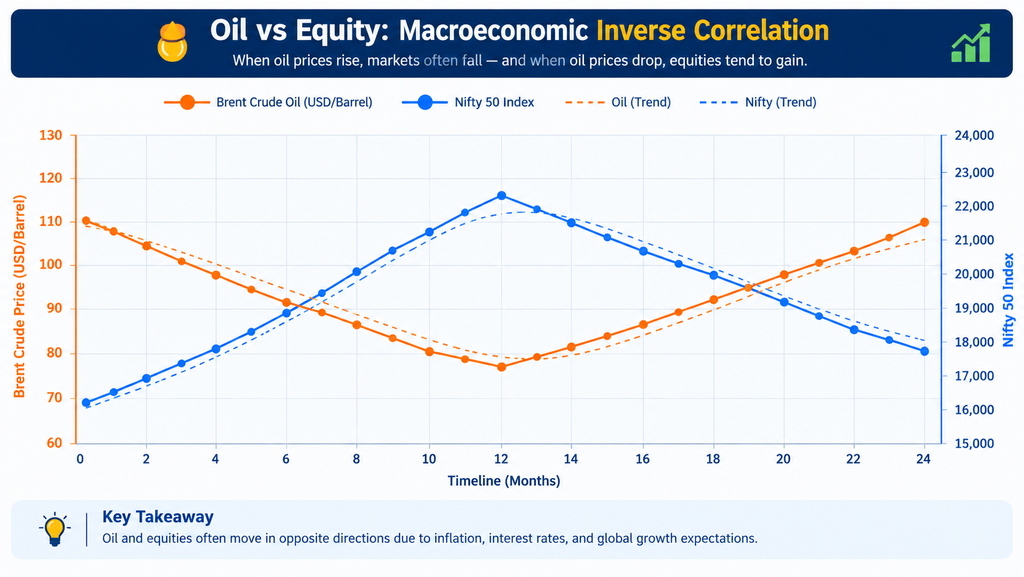
As visualized above, periods of parabolic oil price spikes almost always correspond to consolidation or structural corrections in the broad equity indices due to the mounting pressure on the country’s fiscal architecture.
4. Sectoral Winners and Losers: Mapping Your Portfolio
The relationship between crude oil and the Indian stock market is not entirely negative. While a broad index correction occurs due to macro pressures, specific sectors display completely opposing behaviors depending on where they stand in the supply chain.
The Structural Losers (Squeezed Margins)
- Aviation: Aviation Turbine Fuel (ATF) accounts for roughly 35% to 40% of the total operating expenses of any Indian airline. Since airlines cannot immediately pass on rapid fuel price spikes entirely to consumers without destroying demand, a rally in crude leads to direct margin erosion and stock declines for aviation companies.
- Paints and Petrochemical Derivatives: The paint industry is heavily dependent on crude oil derivatives. Monomers, solvents, titanium dioxide processing, and packaging materials are all linked directly to petrochemical prices. When oil climbs, the raw material cost index for the paint sector surges, compressing gross profit margins.
- Automobiles and Logistics: Higher fuel costs increase the total cost of ownership for consumer vehicles, which can temporarily slow down commercial auto sales. Concurrently, logistics and fleet operators see their margins squeezed unless they implement rigid fuel-surcharge pass-through mechanisms.
The Structural Winners (The Hedging Assets)
- Upstream Oil Exploration and Production (E&P): Companies involved in exploring and extracting domestic crude oil are direct beneficiaries. Since their cost of extraction remains largely fixed, every dollar increase in global oil benchmarks goes straight to their top and bottom line, expanding profit realizations.
- Export-Oriented Sectors (Indirect Winners): Sectors like Information Technology (IT) services and Pharmaceuticals do not use heavy amounts of oil, but they earn revenues primarily in US Dollars. Because high oil prices weaken the Indian Rupee, these dollar earners receive a structural tailwind when translating global revenues back into local currency.
5. Correlating Oil and Margin Behaviour
To understand how input cost inflation translates structurally into corporate performance, we can trace the mathematical correlation between specific commodity variations and sector profitability over time.
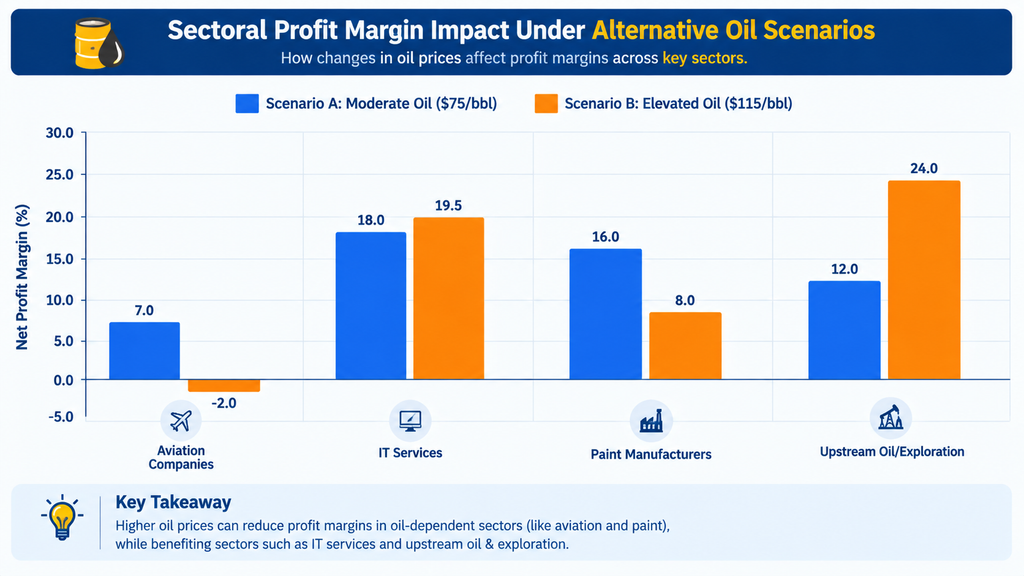
The comparative data reveals exactly why smart asset allocation requires balancing sensitive consumer facing stocks with resilient or commodity-hedged components.
6. Strategic Blueprint for Investors
How should you manage your investment portfolio when global energy headlines turn highly volatile? Financial planners recommend a clinical approach rather than knee-jerk selling.
Look for the Turnaround (The Rubber-Band Effect)
Oil price shocks are historically cyclical. High oil prices eventually act as their own cure by destroying demand or forcing global production capacity to ramp up elsewhere. When crude oil prices finally peak and begin to collapse, the exact reverse of the economic friction occurs: the rupee strengthens, margins expand rapidly, and the Indian stock market typically stages massive, multi-month structural rallies. Experienced investors use oil-driven market corrections to pick up high-quality structural businesses at deep discounts.
Maintain Sectoral Diversification
Never concentrate your portfolio purely in consumer-facing or input-heavy sectors like paints, adhesives, or transport logistics. Ensure adequate weightage in secular sectors like banking, software services, or domestic manufacturing that possess the balance sheet strength to absorb macro shocks.
Final Summary
Crude oil is the ultimate macro variable for the Indian equity ecosystem. While a sudden spike creates structural headwinds by pressuring the national balance sheet, stoking inflation, and altering monetary cycles, it does not alter the long-term underlying growth story of corporate India. By treating oil volatility as a cyclical variable rather than a structural threat, you can look past short-term index corrections, avoid emotional panic, and strategically position your capital to maximize long-term wealth creation.