
Table of Contents
Introduction
Imagine checking your investment portfolio after a busy week, only to see a sea of flashing red numbers. A pit immediately forms in your stomach. Your hard-earned money seems to be evaporating, and the financial headlines are screaming about a sudden downturn.
In moments like these, the human brain is wired to panic. We want to protect what is ours, which often leads to the temptation to log into our brokerage accounts, hit the “sell” button, and crawl into a financial bunker until the storm passes.
But before you make any sudden moves, it is vital to take a deep breath and understand exactly what is happening. The financial media frequently throws around terrifying terms like stock market correction and market crash interchangeably, but they are fundamentally different economic events. Knowing the difference between the two—and having a concrete, unemotional game plan—is what separates successful long-term investors from those who lock in devastating losses.
Let’s demystify these market movements, look at how they historically behave, and map out exactly what you should do to protect and grow your wealth when the market takes a dive.
The Anatomy of a Downturn: stock market correction vs. Crash
To navigate a storm, you must first identify it. While both corrections and crashes represent a drop in stock prices, their severity, velocity, and underlying causes are vastly different.
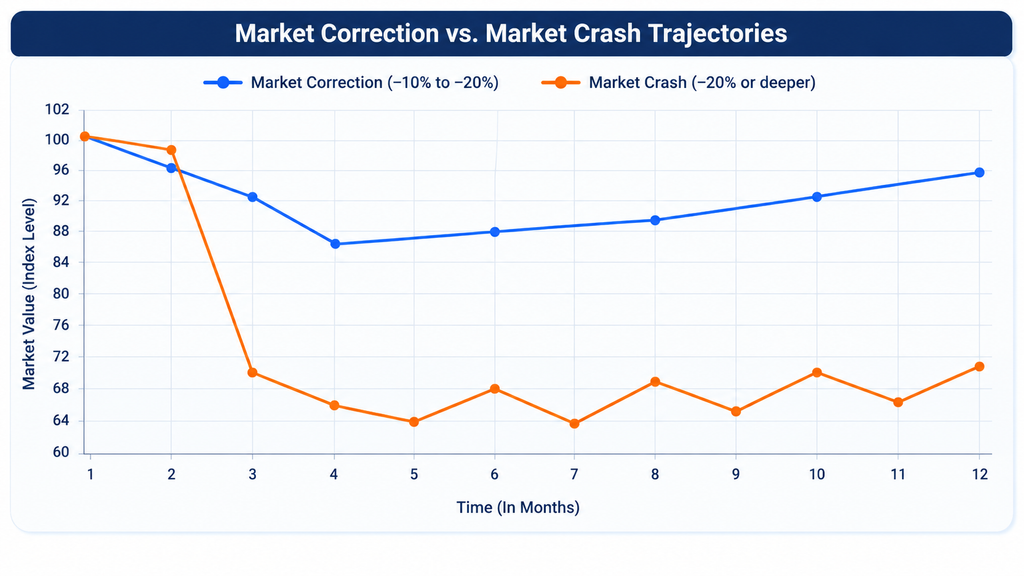
Line chart comparing stock market correction vs crash trajectories over 12 months
What is a Stock Market Correction?
A stock market correction is a measured, relatively common drop in a major stock index (like the S&P 500 or the Nifty 50) of 10% to 20% from its most recent peak.
- The Velocity: They are typically gradual, unfolding over several weeks or months.
- The Cause: Think of a correction as a healthy biological reaction. When the market goes on a long, uninterrupted bull run, stock prices can become overvalued. A correction “corrects” this inflation, bringing stock prices back in line with actual corporate earnings and economic realities.
- The Outcome: Corrections are historically temporary bumps in the road. On average, the market experiences a correction every 1 to 2 years, and they usually resolve themselves within a few months as buyers step back in to snap up discounted stocks.
What is a Stock Market Crash?
A stock market correction is a sudden, drastic, and often chaotic drop in stock prices that plunges the market into a bear market—defined as a decline of 20% or deeper from recent highs.
- The Velocity: Unlike corrections, crashes happen at breakneck speed. Panic selling takes over, and massive amounts of value are wiped out in a matter of days or even hours.
- The Cause: Crashes are rarely just about valuation. They are usually triggered by major macroeconomic shocks—sudden geopolitical conflicts, unexpected economic catastrophes, systemic banking failures, or global black swan events (like the 2008 financial crisis or the 2020 pandemic onset).
- The Outcome: Because crashes are tied to broader economic fractures, the recovery time is significantly longer. It can take months, or sometimes years, for the economy and investor confidence to rebuild.
At-a-Glance Comparison
| Feature | Stock Market Correction | Market Crash |
|---|---|---|
| Magnitude of Drop | 10% to 20% decline | 20% or deeper decline |
| Speed of Decline | Gradual (weeks to months) | Sudden and abrupt (days to weeks) |
| Frequency | Highly common (every 1–2 years) | Infrequent (generational or cyclical) |
| Primary Trigger | Market overvaluation, minor economic shifts | Major economic shocks, systemic panic |
| Recovery Horizon | Short-term (typically 3–4 months) | Long-term (months to several years) |
Why Our Brains Fail Us During Market Drops
Before discussing strategy, we must acknowledge the psychological trap of market volatility. Human beings are deeply prone to loss aversion. Psychologists have proven that the pain of losing $1,000 is twice as intense as the joy of making $1,000.
When you see your portfolio shrinking during a crash or stock market correction, your primal brain reacts as if you are facing a physical threat. It triggers a fight-or-flight response.
- The Fallacy of ‘Doing Something’: We mistakenly believe that acting (selling our shares to stop the bleeding) is safer than doing nothing.
- The Cost of Panic: In reality, selling during a downturn transforms a temporary paper loss into a permanent realised loss. You effectively lock in your losses at the worst possible time and miss the inevitable rebound.
The Strategic Blueprint: What Should Investors Do?
When the market starts dropping, your response should be dictated by a structured financial framework, not by the daily news cycle. Here is your step-by-step action plan, ordered by financial priority.
Phase 1: Secure Your Financial Foundations
Before touching your investments, ensure your immediate financial life is bulletproof. Market downturns can sometimes spill over into the real economy, impacting job security.
- Assess the Emergency Fund: Ensure you have 3 to 6 months of living expenses sitting safely in cash or liquid savings. If a crash deepens, this cash buffer ensures you will never be forced to liquidate your long-term investments to pay rent or buy groceries.
- Clear Toxic Debt: High-interest debt (like credit card balances) is a guaranteed negative return. Prioritise clearing these liabilities before trying to “buy the dip.”
Phase 2: Deploy the “Do Nothing” Strategy (For Core Assets)
If you are invested in broad-based, low-cost index funds or high-quality blue-chip companies, the absolute best strategy during a stock market correction or crash is often to do nothing at all.
- Turn Off the Noise: Stop checking your portfolio daily. The daily fluctuations are meaningless noise in a multi-decade investing journey.
- Automate Your Investments: Keep your Dollar-Cost Averaging (DCA) or Systematic Investment Plans (SIPs) running automatically. When the market drops, your fixed monthly investment automatically buys more shares at cheaper prices. When the market recovers, those extra shares supercharge your returns.
Phase 3: Strategic Rebalancing and Portfolio Cleanup
A market downturn exposes the structural flaws in a portfolio. Use this time for a clinical, unemotional review.
- Rebalance Assets: If a crash has caused your stock allocation to shrink and your bond allocation to grow, sell a portion of your bonds to buy equities. This forces you to mathematically adhere to the golden rule of investing: buy low, sell high.
- Harvest Tax Losses: If you hold individual assets at a loss in taxable accounts, consider tax-loss harvesting. You can sell underperforming assets to offset capital gains taxes elsewhere, then immediately redeploy that capital into diversified index funds.
Action Plan Based on Your Investor Profile
Your specific response to a correction or a crash depends heavily on your age, financial timeline, and risk tolerance. Find your category below to see your tailored strategy.
1. The Accumulator (Ages 20–45)
If you have 15, 20, or 30 years left before retirement, a stock market crash or stock market correctionis a gift.
- The Perspective: You are a net buyer of stocks. Would you get upset if your favourite grocery store suddenly put high-quality food on a 30% discount? Of course not.
- The Play: Maintain your career income, keep your regular contributions active, and if you have excess cash beyond your emergency fund, aggressively deploy it into broad market ETFs. Historically, the fortunes of the future are built during the crashes of the present.
2. The Near-Retiree (Ages 46–60)
If you plan to retire within the next 5 to 10 years, your timeline is compressed, meaning you have less time to wait out a multi-year recovery.
- The Perspective: Protection and mitigation take priority over aggressive buying.
- The Play: Do not panic-sell your existing stocks. Instead, evaluate your asset allocation. Ensure you have a solid runway of non-equities (bonds, fixed deposits, cash) so that you won’t have to draw down on crashed stock assets the day you stop working.
3. The Retiree (Ages 60+)
If you are currently living off your investment portfolio, a crash requires immediate, tactical cash-flow management.
- The Perspective: You must avoid the “Sequence of Returns Risk”—the danger of withdrawing money from a severely diminished equity portfolio.
- The Play: Pause any discretionary, non-essential withdrawals from your stock bucket. Live off the yields, interest, and cash reserves you prudently built up during the bull market years. Leave your equity investments alone so they have the breathing room to recover.
The Golden Rules of Navigating Volatility
The Golden Rules of Navigating Volatility To ensure you survive and thrive through any future market volatility, keep these three timeless principles pinned to your financial dashboard:
- Market Timing is a Myth: No one can consistently predict exactly when a correction will turn into a crash, or when a crash will hit rock bottom. Waiting on the sidelines for the “perfect time to buy” usually results in missing the explosive early days of a market recovery.
- The Market is Resilient: Every single crash, panic, depression, and correction in financial history has ended the exact same way: with an eventual recovery to new all-time highs. The global economy is driven by human innovation and the collective desire of companies to generate profits. Bet on that long-term human progress.
- Diversification is Your Shield: If your portfolio is concentrated in a couple of trendy tech stocks or speculative assets, a crash can ruin you. But if you are globally diversified across thousands of companies, real estate, and fixed-income assets, a crash is merely a temporary dip in a long upward trajectory.
Final Thoughts
Stock market corrections and crashes are not anomalies; they are mandatory features of the financial system. They are the price of admission we pay for the long-term, inflation-beating returns that the stock market provides.
The next time the headlines turn red and panic spreads across social media, do not look at your portfolio as money lost. Look at it as a storm passing through an orchard. The trees might bend, and a few loose leaves will fall, but as long as the roots are deep and you don’t chop the trees down in a panic, the harvest will return stronger than ever. Stay patient, stick to your plan, and let time do the heavy lifting.
To help tailor this investment approach to your situation, please share:
- Your approximate investment time horizon (e.g., retiring in 5 years, investing for 20+ years).
- The type of assets you currently hold (e.g., individual stocks, index funds, mutual funds).
- Your comfort level with portfolio volatility (e.g., nervous about any drops, or comfortable buying the dip).